

Imagination

_svg.webp)


Is this beautiful Japanese woman
wearing this beautiful garment? Or is she taking it off?
I came across this one painting by pure chance about five years ago. I couldn't look away. That beautiful garment — that intense, electric indigo and black, the slight twist of her body, and the soft, voluminous curves of her kimono, puffed up like a hanbok. The first question that came to my mind was exactly that.
It is hands down the best painting I have seen in recent years. I had to know. Who made it? When? Why? That was the beginning.
People look at photographs. And they look at paintings. I love looking at paintings. I like to empathize with the artist, to fully feel what he or she felt while creating it. This painting was like that. That was the beginning.
When you look at a painting, do you read the title and description first? I don't. I don't read the title first. I don't read the description either. I just stare at it for a long time, trying to find that one moment the artist was trying to express. But some paintings — especially abstract ones like modern abstract paintings — no matter how hard I try, I just can't understand them. So in the end, I always read the title and description. To truly understand what he or she was trying to express.
This painting is Courtesan Wearing a Dragon-Patterned Uchikake (Courtesan Facing Left) by Katsukawa Shunsen (勝川春扇, c. 1762–1830). ca. 1830–1840, kakemono-e woodblock print. Major holding: Fine Arts Museums of San Francisco, Legion of Honor, Achenbach Foundation for Graphic Arts. The original title is Woman Facing Left (Yūjo Facing Left), and other impressions of the same edition are held by the British Museum and other institutions.
Here is the important fact. What she is wearing is not the kimono we commonly know. It is an uchikake (打掛). A kimono is tied at the waist with a koshi-himo. It turns the body into a cylinder and erases its curves. But an uchikake is not tied. It is a formal outer robe draped over the shoulders that trails on the floor. Only brides and oiran were allowed to wear it.
So my initial question becomes valid again. Is she wearing it, or taking it off? Because it is not tied, the magnificent indigo dragon on her robe flows uninterrupted from her chest to her hips. That striking indigo is bero-ai (Prussian blue), imported from the West in the late Edo period. The most expensive, the deepest blue. A color only the highest-ranking courtesans of Yoshiwara could wear.
Yoshiwara (吉原) was Japan's largest licensed pleasure quarter, located just outside Edo (present-day Tokyo). In 1617, the shogunate established it, saying, "We will gather the prostitutes in one place and manage them." It was not just a brothel village. It was Edo's fantasy world — its Walt Disney World. A city within a city, surrounded by walls. To enter, you had to pass through a single gate. Inside, more than 3,000 yūjo lived. Liquor, fashion, and art that could not be enjoyed outside were permitted only inside. Every man in Edo dreamed of saving his salary to go to Yoshiwara at least once in his life.
The hierarchy was strict. If you had no money, you were a hashijorō (端女郎), standing on the street soliciting clients. If you had some money, you were a chūsan (中散), receiving guests in a room. And at the very top was the oiran.
An oiran chooses her clients. The client does not choose the oiran. A client has to pay and come three times just to meet her. On the first day, you only see her face and leave. On the second day, you only drink and leave. Only on the third day can you sleep with her. That is how precious she was. That is why only they could wear the indigo uchikake with the dragon. In Edo, the dragon was a symbol of masculinity, power, and the shogun. For a woman to wear it was itself a declaration: "I am the queen of this Yoshiwara."
So the Japanese woman in this painting is not just a pretty woman. In 1830s Tokyo, she was the most expensive, the most powerful, and the most desired woman.
Yūjo (遊女) literally means "a woman who plays," and in Japan it is the general term for a prostitute. The ranks are divided like this:
-
yūjo: the broadest term, referring to all women who sell their bodies
-
oiran: the highest rank among them. A title used only in Yoshiwara. A woman of high status who can choose her clients. She belongs to this category.
-
geisha: a woman who does not sell her body but sells her art
She is an oiran even among yūjo. Because only an oiran could wear the dragon.
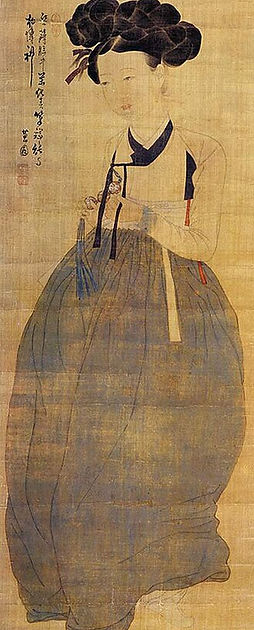
Is this beautiful Joseon (present-day Korea) woman
trying to stand up? Or trying to sit down?
This painting is Portrait of a Beauty (Miindo) by Shin Yun-bok (申潤福, 1758 – after 1813, date of death unknown), art name Hyewon (蕙苑). Same period as the Album of Genre Paintings by Hyewon (Hyewon Pungsokdo-cheop), National Treasure No. 135, ca. 1800–1805. Color on silk, yukpil-hwa (hand-painted work, not a print). Currently designated Treasure No. 1973, housed at the Kansong Art and Culture Foundation.
Along with Kim Hong-do, Hyewon was one of the two giants of late Joseon pungsok-hwa (genre painting). His Miindo is almost the only work in Joseon to depict a woman’s full body as the sole protagonist. Using portrait-painting technique, he rendered every single strand of hair and completely erased the background. Only one woman remains.
Here a question arises. Is this beautiful Joseon woman trying to stand up? Or trying to sit down? An ambiguous posture, as if she is standing but not quite standing. She seems to be looking at something, but you have no idea what she is looking at. She is just fiddling with her norigae (a traditional Korean ornamental pendant worn on hanbok) with her left hand.
If the Japanese oiran expressed the dragon as if it were alive and about to leap into the sky, the Joseon beauty maximized a woman’s curves by puffing up her hanbok chima (the voluminous, wrapped skirt of hanbok) to the fullest.
The oiran was erotic because she was not tied, and the Miindo is erotic because she is tied too much.
A Joseon chima is three layers. Sok-chima (inner skirt), geot-chima (outer skirt), and norigae on top of that. Tied and tied again to hide the body, and that is why it shows even more. That ambiguous curve of being about to stand, that one finger fiddling with the norigae, drives me crazy.
The gisaeng (a Joseon-era female entertainer and courtesan, trained in arts and poetry) in the hand-painted Miindo by Shin Yun-bok and the Japanese oiran in the woodblock print by Katsukawa Shunsen overlapped in my mind. But they were different. Just as Hyewon of Joseon lifted the gisaeng’s chima hem with a brush, Shunsen stamped the oiran’s curves with a writhing, ascending dragon in the form of an uchikake. Joseon and Japan — the form of depiction was different, but the desire of the two was the same.
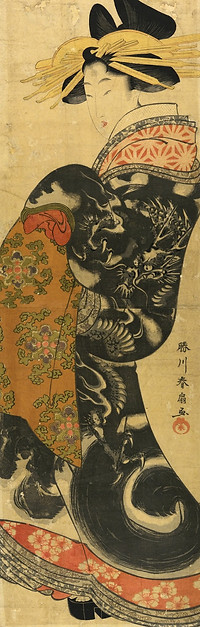
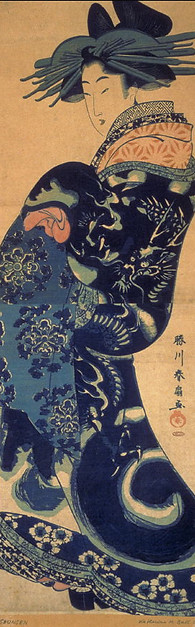
Same woodblock, different feeling.
Which painting moves you more?
The painting I first encountered about five years ago was the one on the right, the oiran with the striking indigo dragon pattern. I still cannot forget the excitement I felt at that time. It was so intense that the memory of that moment still remains.
At first, I just thought, "It's just a woodblock print, similar composition to Shin Yun-bok's Miindo," — that one image in my distant memory.
Then as time passed, by chance I came across another work on the left, the same woodblock but printed in black. It is Katsukawa Shunsen’s Oiran Wearing a Dragon-Patterned Uchikake (ca. 1810). Here, ca. is an abbreviation for circa, meaning "around." Approximately this period. Japanese woodblock prints do not have dates printed on them, so art historians estimate the date from pigments and publishing methods.
In other words, it was a woodblock printed about 20 years earlier than the work on the right. I was shocked here. I was shocked once that this work had already been made about 20 years earlier, and shocked again at how different it could feel just because the color changed even though it was the same block.
-
Left black dragon: Sumi (墨, ink) and aigami (藍紙, indigo-dyed paper). Indigo fades quickly. So it is dull and heavy. The dragon is hidden.
-
Right indigo dragon: Bero-ai (Prussian blue). After the 1830s. It does not fade. It is vivid. The dragon is alive and writhing.
This dragon-patterned oiran by Shunsen, whose first edition was printed around 1810, and Shin Yun-bok’s Miindo, painted around ca. 1800–1805. The two artists are only four years apart in age. And above all, the very fact that despite being from different countries, they each painted the most famous gisaeng of Joseon and the oiran of Japan in their own country with a similar composition — that fact itself truly excited me.
Isn't it interesting?
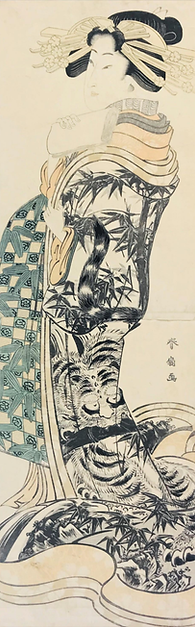
While I was enjoying my own hobby, looking for similarities and differences between these two works, one day I came across this work.
Katsukawa Shunsen’s Oiran Wearing a Tiger-Patterned Uchikake (ca. 1810–1820). I couldn't shake the feeling that the draftsmanship had dropped so much that it hardly seemed to be by the same person. It was not gorgeous, and it gave a strong impression that did not befit the rank of oiran.
This was the beginning.
So I imagined.
If I were an art historian —
"If I were an art historian, how would I write a thesis about this painting?"
If you add historical mystery to historical fact and imagine, it can become a universal imagination. Not just my own delusion, but a mischievous imagination that anyone can enjoy together, thinking "Huh? That could be possible?" So I actually wrote it. Like a real thesis by an art history student.
The most serious joke in the world, and my universal imagination, written after five years of deep fandom by a Korean-Australian digital creator who graduated in a field completely different from his major. Now it begins.
I hope you enjoy the imagination.
-
Digital Creator / Art Historian in Imagination, Shane Lee @aushanelee
Title: The Dragon in the Black Kimono: A Re-examination of Katsukawa Shunsen’s Oiran Wearing a Dragon-Patterned Uchikake (c. 1810)
Subtitle: Both Miindo Are National Treasures – An Imagined Record of the Boat Shin Yun-bok Boarded in 1811
Author: Shane Lee @aushanelee
-
B.E. Civil & Environmental Engineering, Korea University (2003), Le Cordon Bleu Australia, Commercial Cookery (2011) & UTS, Medical Science (2020)
Oiran with Dragon Pattern, Katsukawa Shunsen (c. 1810)
Abstract
This paper begins with a marked discrepancy in skill between two works attributed to Katsukawa Shunsen (勝川春扇, 1762–ca. 1830): Oiran Wearing a Dragon-Patterned Uchikake (ca. 1810, listed in the Lyon Collection database, with a similar impression held by the British Museum) and Oiran Wearing a Tiger-Patterned Uchikake (ca. 1810–1820, no record of public institutional holding, circulated through auction).
Despite being attributed to the same artist, sharing a similar composition, and falling within the narrow window of the 1810s, the two works show striking differences in pigment saturation and preservation, morphology of the costume silhouette, fine-brush technique, woodblock printing technique, and art-market circulation. In particular, Shunsen’s cessation of woodblock print production in the late 1820s and his transition to porcelain overglaze painting is anomalous even among his ukiyo-e contemporaries.
This study comprehensively examines the historical context of late Joseon painting after King Jeongjo’s reign, changes in the Dohwaseo (Royal Bureau of Painting) system, formal analysis of Shin Yun-bok’s (申潤福, b. 1758) Miindo (Portrait of a Beauty), an engineering analysis of the ukiyo-e division-of-labor system, auction database analysis, comparison with Kim Hong-do’s painting methods, the 1811 Shinmi Tongsinsa (Joseon diplomatic mission to Japan) records of stay in Tsushima, the role of interpreters at the Waegwan (Japan House in Busan), the record of interpreter Pi Jong-jeong — a maternal relative of Shin Yun-bok — accompanying the mission to Tsushima, and the pigment distribution routes via Busan Waegwan, to present one hypothesis.
Furthermore, it adds an art-historical conjecture about what kind of works a painter expelled from the Dohwaseo would have brought with him if he had crossed to Japan, and discusses two interpretive possibilities in an integrated manner. This paper does not assert either hypothesis as definitive, but juxtaposes the two to provide a starting point for future research.
-
Hypothesis 1. Inspiration Hypothesis: The possibility that Shunsen was inspired by the format of Shin Yun-bok’s Miindo and reinterpreted it in a Japanese style.
-
Hypothesis 2. Conjecture on Additional Exported Works: An art-historical conjecture on the additional body of works that could have accompanied a painter expelled from the Dohwaseo if he had crossed to Japan.
This paper has no intention whatsoever of denigrating the artistic value of Japanese ukiyo-e. On the contrary, as confirmed by the British Museum’s holding of a related impression, the Dragon-Patterned Uchikake series is already recognized as a museum-grade masterpiece in terms of technical completeness.
Oiran wearing a dragon pattern? This looks so much like Shin Yun-bok’s Miindo? A kimono can’t produce this kind of voluptuous, curved beauty — what is this? That feeling. Of course, the work I first encountered was not this black early edition but the other blue version from around 1830–1840, but anyway, I literally gasped when I saw this painting. Because it was so beautiful.
Chapter 1. A Genius Does Not Regress at the Same Time
1.1 The Career of Katsukawa Shunsen
Katsukawa Shunsen (勝川春扇, 1762–ca. 1830, also known as Shunko II) was a designer of book illustrations and ukiyo-e style woodblock prints, known for genre paintings, landscapes, and bijin-ga (beautiful woman paintings) using Western-style perspective. Initially he studied under the Rimpa painter Tsutsumi Torin III under the art name Shurin (春林), and around 1806–1807 (ca. 1806–1807) he became a disciple of Katsukawa Shun’ei, taking the name Kojimachi Shunsen before changing it to Katsukawa Shunsen. In 1820 he succeeded Katsukawa Shunko I and became Shunko II. After around 1821, he appears to have stopped producing prints and book illustrations and concentrated on ceramic painting. The exact reason for this transition is not known. It has been suggested that it may have been influenced by economic factors in the ukiyo-e market or commercial opportunities in ceramic decoration, but there is no documentary evidence that clearly explains his decision.
[Academic Note – The Anomaly of the Transition to Ceramics]
First, the continuity of output of contemporary ukiyo-e painters should be considered. Hokusai (1760–1849) continued to publish new works and woodblock prints even after his 70s, and Utagawa-school artists such as Kunisada also maintained print production into old age. By contrast, Shunsen’s shift from large-format nishiki-e prints to small-scale ceramic painting around age 60 is regarded as anomalous even within the Katsukawa school.
Second, the gap becomes even more pronounced when we look at the production technique of Oiran with Dragon Pattern (ca. 1810, listed in the Lyon Collection database, with a related impression held by the British Museum). It is a work that concentrates high-level techniques of the time, such as multi-block multi-color overprinting, bokashi (gradation), and kira-zuri (mica printing). That an artist with a record of mastering techniques at this level would stop print production about ten years later and concentrate on ceramic painting has led to various interpretations — economic factors, commercial opportunities in the ceramic decoration market — but no documentary evidence that clearly explains this has been confirmed to date.
Third, this paper examines one possible interpretation at this point. If we consider the possibility that an external original painter collaborated in the production process of Oiran with Dragon Pattern around 1810, it is difficult to rule out the possibility that changes in the production method or level appeared after a change in that collaborative relationship. The gap in skill observed in Oiran with Tiger Pattern can also be interpreted in this context. Of course, this is still a conjecture for which no direct documentary evidence has been confirmed to date, and verification through future discovery of additional materials is necessary.
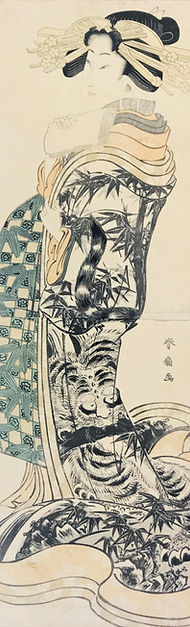
Oiran with Tiger Pattern, Katsukawa Shunsen (1810-1820)
I started to think, what if Shunsen was in charge of the woodblock, and someone from the outside was in charge of the painting? Like what we would call a collab today. Because it felt so weird — how could someone who could create a top-tier masterpiece like Oiran with Dragon Pattern later make something like Oiran with Tiger Pattern (ca. 1810–1820) so carelessly? It was the opposite of what you'd expect from a great artist who always shows only his best. That was when one person came to mind.

1.2 Comparison with Kim Hong-do – A Genius’s Brushwork Does Not Collapse Within a Narrow Time Frame
Kim Hong-do (金弘道, 1745–after 1806) is Joseon’s greatest court painter. Let us look at his tiger paintings. Songha Maenghodo (Tiger under Pine Tree) and Jukha Maenghodo (Tiger under Bamboo) maintain the same level in brushwork, depiction of tiger muscles, fine whisker strokes, and background treatment, even though they were produced several years apart. The skill of a genius painter does not collapse within a short time frame. This is art-historical common sense. However, that common sense is broken in Shunsen’s works of the 1810s.
-
Works from 1800–1809: Relatively flat composition, low saturation, cylindrical vertical folds, mainly single-block printing.
-
ca. 1810 Oiran with Dragon Pattern (ca. 1810, listed in the Lyon Collection database, with a related impression held by the British Museum): Multi-block multi-color, bokashi, kira-zuri, triple overprinting and other highest-level techniques all mobilized. Three-dimensional depiction, bell-shaped S-curve silhouette. Already evaluated as a museum-grade masterpiece as confirmed by the British Museum’s holding of a related impression.
-
ca. 1810–1820 Oiran with Tiger Pattern (ca. 1810–1820): Return to single block, flat composition, no overprinting technique, regression to vertical folds.
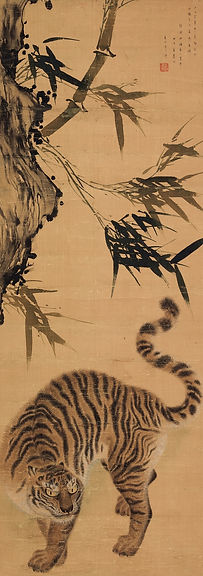
Songha Maenghodo, Kim Hong-do
(c. 1780s)
Jukha Maenghodo, Kim Hong-do
(c. 1790s onward)
Despite sharing the same attributed artist, same composition, and same subject — a high-ranking oiran wearing an uchikake with a beast motif — the technical and formal disparity that appears within the narrow window of the 1810s is difficult to explain solely by the internal development of a single artist. It requires consideration of various interpretive possibilities, including a change in the production agent. As Kim Hong-do’s case shows, a genius painter does not work like that. In Shunsen’s case, this divergence constitutes the strongest formal evidence for inferring the intervention of a different hand — that is, the possibility of collaboration with an external original painter.
1.3 The Overlooked Point – That It Is a Woodblock Print: Coexistence of Masterpiece and Mass-Market Product
There is an important premise that was overlooked in the comparison in 1.2. Kim Hong-do’s tigers are yukpil-hwa (hand-painted paintings), while Shunsen’s oirans are mokpan-hwa (woodblock prints).
Kim Hong-do’s Songha Maenghodo and Jukha Maenghodo are the result of Joseon’s greatest painter taking up a brush for a single work. Because it is a one-of-a-kind hand-painted work, there is no reason for the brushwork to collapse within a short time frame. It is natural for the greatest painter to give his utmost.
However, Shunsen’s two oirans are printed images. Even with the same original drawing, it can become a masterpiece or a mass-market product depending on how it is printed. That woodblock prints can produce many copies and can be divided into grades and sold according to production cost is the decisive difference from hand-painted works.
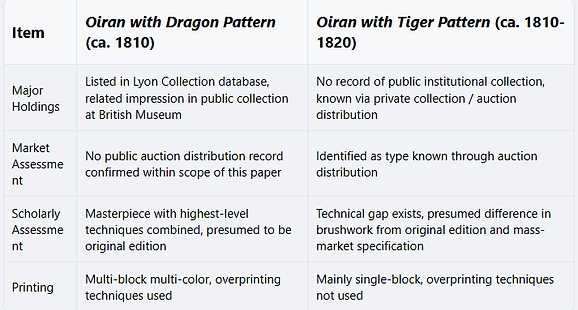
Let us compare the two works presented again. One is ca. 1810 Oiran with Dragon Pattern, registered in the Lyon Collection database and confirmed to have a related impression held in public collection at the British Museum, corresponding to a high-grade specification where the highest-level techniques of the time such as multi-block multi-color, bokashi, kira-zuri, and triple overprinting are concentrated. The other is ca. 1810–1820 Oiran with Tiger Pattern, whose record of public institutional collection has not been confirmed to date and is known through auction distribution copies, presumed to be a mass-market specification centered on single block without overprinting techniques.
Putting these two side by side allows another interpretation of the skill gap raised in 1.2.
First, the publisher’s price segmentation strategy. Oiran with Dragon Pattern corresponds to a luxury, masterpiece specification where multi-block multi-color, bokashi, kira-zuri, and triple overprinting are fully mobilized. By contrast, Oiran with Tiger Pattern may have been produced as a low-cost mass-market specification, printed mainly on single block, omitting gold leaf and overprinting. Dividing the same design into high-grade and low-grade to sell was a common practice in the Edo publishing industry. Therefore, the technical simplicity observed in the tiger pattern may not be a decline in Shunsen’s individual skill, but rather the result of the publisher’s intentional product strategy.
Second, woodblock wear. Woodblocks are consumables. If you print hundreds of sheets, the lines become blunt and fine details dull, making precise printing no longer possible. In the process of continuously printing the block that had already achieved commercial success with the dragon pattern, it cannot be ruled out that the blunt lines and flat coloring of the tiger pattern that we currently see in auction distribution copies are the result of wear from later impressions.
Therefore, I do not conclude that the “skill gap” raised in 1.2 is a regression of Shunsen as an individual. Rather, if understood as a dual structure where the dragon pattern is a museum-grade masterpiece and the tiger pattern is a mass-market product, the gap within the narrow window of the 1810s can be reinterpreted not as a problem of artist theory but as a problem of publishing and distribution theory. This paper acknowledges that even if the level of Oiran with Tiger Pattern appears lower, it does not necessarily mean that the level of the painter himself declined.
Of course, this interpretation also has limitations in that it is currently inferred only from the Lyon Collection registered image and auction distribution images, and verification through future empirical research such as physical comparison of first and later impressions and confirmation of surviving woodblocks is necessary.
1.4 Distribution – The Market Has Already Separated the Original and the Low-Cost Reprint
The dual structure of masterpiece and mass-market product presumed in 1.3 is also confirmed in the distribution path. First, for the ca. 1810 Oiran with Dragon Pattern type, within the scope confirmed by this report, no public auction market transaction history is confirmed. Registered in the Lyon Collection database and understood to have a related impression held in public collection at the British Museum, and with no transaction of the same specification reported on private auction databases to date, it suggests the possibility of a restricted, museum-grade specification with limited distribution.
On the other hand, the ca. 1810–1820 Oiran with Tiger Pattern type has no record of public institutional collection confirmed to date and is a type known through auction distribution copies, and is thus distinguished in its distribution path itself from the previously mentioned museum-grade type of the dragon pattern. This can be interpreted as a case showing that even within the same oiran composition, the high-grade multi-block version and the low-cost single-block version were separated, evaluated, and distributed from the distribution stage itself. Of course, this is an inference based on the history on online databases confirmed to date, and verification through additional confirmation of original auction catalogs and sales records in the future is necessary.
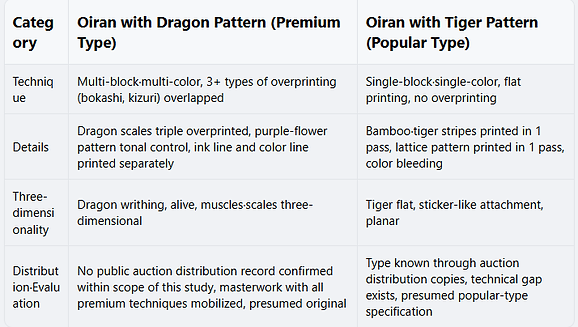
Table 1. Comparison of holding and distribution status of two works
I realized later that my perspective was stuck in yukpil-hwa — I was looking at this painting from the viewpoint of a painting drawn with a brush. In middle and high school history class I learned about Kim Hong-do and Shin Yun-bok as Korea’s two famous genre painters. Among them, Shin Yun-bok’s Miindo — doesn’t this painting look so similar to it? It was the moment I realized I had an unconscious fixed idea that a painting means a brush painting. Even while saying it was a woodblock print, I was trapped in the standard of a brush painting like Shin Yun-bok’s Miindo and thought that if Oiran with Tiger Pattern came after Oiran with Dragon Pattern, there should be two paintings of the same skill level, like Kim Hong-do. I was unconsciously applying that fixed idea. There is no woodblock print tradition in Korea. So it felt unfamiliar. But as I researched, I learned the unique characteristic of woodblock — that it can be sold in two types, a work for the masses and a luxury masterpiece — and I also looked into the Japanese distribution system. The experience of my narrow perspective shattering while tracing one artist’s masterpiece. You really don’t know until you experience it. It was really freaking thrilling.
Chapter 2. On the Morphological Identity of Miindo and Oiran with Dragon Pattern – What Looked Like a Brush Was a Knife
On the Morphological Identity of Miindo and Oiran with Dragon Pattern
Shin Yun-bok’s Miindo and Katsukawa Shunsen’s Oiran with Dragon Pattern differ in production background and collection history, yet show a surprising degree of identity in formal structure.
First, omission of background. The general form of late Joseon genre painting lies in the organic combination of figure and background. In Kim Hong-do’s and Kim Deuk-sin’s miindo, mountains, rocks, furniture and other concrete spaces are arranged to complement the narrative. However, Shin Yun-bok completely deletes such background to white and emphasizes only the woman herself. It is a radical gesture that erases the world and forces focus solely on the existence of the woman. Oiran with Dragon Pattern takes the same composition. The norm of bijin-ga in Japanese ukiyo-e is that interior decorations such as screens, braziers, and gardens exist, but in Oiran with Dragon Pattern, all background is omitted. This is an extremely exceptional case in Edo-period ukiyo-e, suggesting the possibility of influence from Shin Yun-bok’s format.
Second, silhouette of clothing. The hanbok chima in Shin Yun-bok’s Miindo is voluminously inflated in a bell shape, and the folds are treated gracefully with S-shaped curves. It is not a realistic depiction of the actual hanbok structure, but an idealized brush method to maximize feminine curvature. The norm of the uchikake worn by a Japanese oiran is that, based on a cylindrical structure, folds fall vertically. However, the clothing in Oiran with Dragon Pattern shows not vertical folds but a bell-shaped silhouette with S-shaped curves identical to Joseon hanbok. It can be interpreted as ignoring the physicality of kimono and directly transplanting a Korean-style idealization. The application of S-curves ignoring the cylindrical structure of uchikake is difficult to explain by inertial transformation within Japanese painting groups alone.
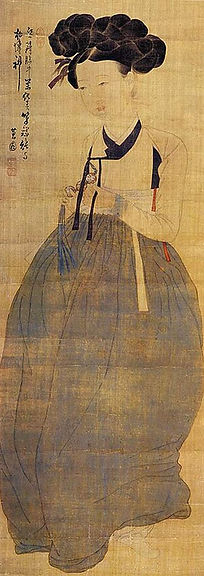

Miindo, Shin Yun-bok
(approx. before 1800s)
Oiran with Dragon Pattern, Katsukawa Shunsen (1830-1840 version)
Third, fine brushwork and rich coloring. Delicate lines achieved with fine brushes and rich coloring act as a painter’s fingerprint. In particular, the extremely fine brush operation for lips, cheeks, and hair, and the dotting of dense red pigment, recurs repeatedly. The use of yeonji with extremely heightened saturation and the technique of allowing slight bleeding inside the contour are consistently observed throughout Shin Yun-bok’s works. That these features appear identically in Korea’s treasure Miindo and Japan’s Oiran with Dragon Pattern is important visual evidence showing that they share the same formal vocabulary and sense of coloring. The coincidence of such brush habits despite differences in medium becomes a clue for presuming the transmission route of the image.
Fourth, facial structure and exaggeration of the coiffure. The face in Shin Yun-bok’s Miindo forms an inverted triangle with a wide forehead and pointed chin, and the eyes are treated as long, narrow, triple-white eyes. This creates a somewhat decadent and voluptuous impression. In particular, the gache (Joseon dynasty women’s large wig made of false hair, exaggerated for status and beauty) is enlarged to more than twice its actual size, soaring high to form a massive sculptural beauty. The face in Oiran with Dragon Pattern also consists of the same inverted-triangle proportion and triple-white eyes, which is a completely different structure from the norm of round faces and drooping eyes of Japanese oiran. Also, the principle of Japanese-style mage (the traditional Japanese topknot, normally tied low at the back) is to tie it low behind, but the hairstyle in Oiran with Dragon Pattern takes a form that soars vertically high, like a Joseon-style gache. That even the facial proportions and the method of exaggerating the coiffure match is a decisive point showing that the two works share the same aesthetic consciousness.
Of course, this examination is based on formal comparison through currently extant plates and public images such as the Lyon Collection, and follow-up research through scientific verification such as pigment analysis, paper quality investigation, and comparison of seals and inscriptions in actual objects is necessary.
I was mistaken. The picture Shunsen drew was not with a brush but with a knife. He carved that soft curve with that knife. How easy could that have been? It is not even an object that can be compared to a picture drawn with a brush. Whether he was influenced by Shin Yun-bok’s Miindo I do not know, but the composition and color sense that this painting shows were enough to remind me of it. That is why I began to build Hypothesis 1 and search persistently. Because I clearly remember seeing that vivid, piercing blue that Shin Yun-bok expressed in Hyewon Jeonsincheop. I will talk about that in more detail later.
Chapter 3. Formal Analysis of Katsukawa Shunsen's Oiran with Dragon Pattern
3.1 Pigment Form: Comparison of Joseon Traditional Jjok·Yeonji and Bero Blue·Jusa
Table 2. Pigment Form Comparison
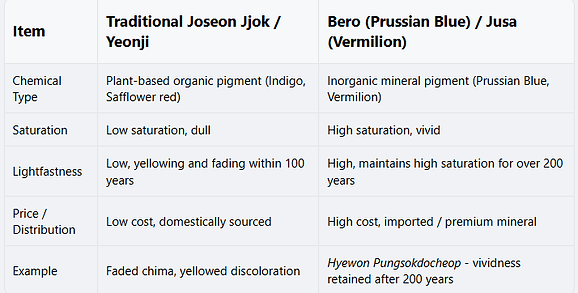
The subject is not the first edition itself. In the first edition around 1810, the dragon pattern was expressed in black, which appears to be due to the physical limitation caused by the high price of bero blue at the time. What this study focuses on is the phenomenon where, in the later edition from the 1830s–1840s, the dragon pattern appears replaced by high-chroma bero blue. This phenomenon can be understood within the contemporary context of the aizuri-e (blue-printed picture) trend of the 1830s, and this chapter analyzes its technical aspect. Meanwhile, Shin Yun-bok had already skillfully used the bero blue series throughout Hyewon Pungsokdocheop (c. 1805, an album of 30 genre paintings satirizing and caricaturing the yangban — the highest elite class of Joseon — through scenes of daily life, housed in Kansong Museum), showing that its adoption in Joseon preceded the trend in Japan. However, hand-painted painting and woodblock print cannot be directly compared technically, and particularly, the case of Hyewon Pungsokdocheop, which achieves in hand-painting a tonal control similar to the overprinting effect in woodblock printing, can be highly evaluated in terms of its proficiency.
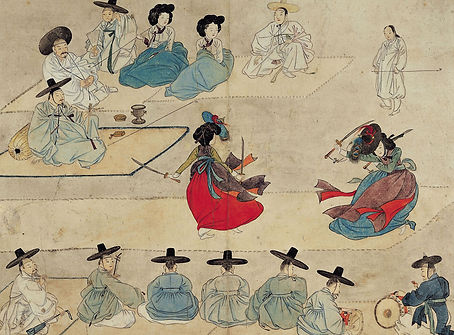
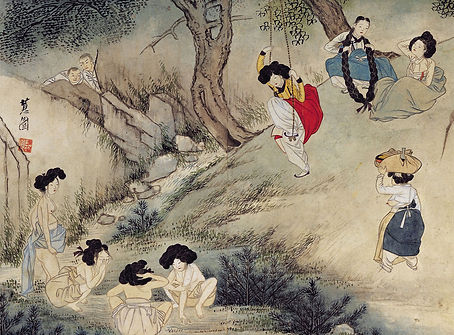
Left: Shin Yun-bok Ssanggeomdaemu (Double Sword Dance), Right: Geune (The Swing) / From Hyewon Jeonsincheop (Hyewon Pungsokdocheop)
– Kansong Museum Collection / c. 1805
In these two paintings, Shin Yun-bok shows the culmination of his aesthetic world. He expressed a rich spectrum of colors by mixing natural pigments jjok (indigo) and yeonji (safflower red), imported premium inorganic pigments bero blue (Prussian blue) and jusa (vermilion), and even ink. And his method of using those colors is genius. He uses a more vivid red and a more vivid blue only for the protagonist. It forcibly grabs the viewer’s gaze.
First painting: the woman dancing with swords in the center is the protagonist. Second painting: the woman about to ride the swing is the protagonist. He used jusa (vermilion) to create a vivid red, and with that one vivid red he completely captures the gaze. This characteristic continues in later Joseon gosa-inmul (scholar-figure paintings). Placing the child monk in vivid red clothes at the center and maximizing immersion with a triangular composition using trees. He makes you see the child monk first inside one frame, then moves your gaze naturally to surrounding figures. That genius idea of guiding the viewer’s gaze already started in this painting.
After seeing the dancer in the vivid red chima dancing with a sword on the left, your eye naturally moves to the dancer on the right. Her chima was colored with yeonji. After seeing the woman in the vivid red chima on the right, the gaze naturally moves to the woman wearing vivid blue with her hair braided long. Shin Yun-bok pursued distinction by using expensive pigments — jusa (vermilion) for vivid red — only for the main character. And that too around 1805. This single fact alone makes you realize again how genius his sense of color was.
In addition, in Shin Yun-bok’s Miindo seen earlier, he uses the same grammar. The whole is laid calmly with jjok, and only at a decisive point — like a thin string coming from the armpit — he used a tiny amount of jusa (vermilion) to create a vivid red accent.
And 30 years later, when we look again at Shunsen’s Oiran with Dragon Pattern (c. 1830–1840), bero blue was used and a little yeonji is seen. Jusa (vermilion), the vivid red, was not used. It is the aizuri-e (藍摺絵, blue-printed picture mainly using bero-ai) technique that was popular in Japan at the time. The reason lies in the practicality of woodblock printing. In the 1830s, bero blue (bero-ai) was imported in large quantities to Japan via China, the price dropped and it became popularized. But jusa (vermilion), the source of vivid red, was still expensive. Due to the characteristic of woodblock printing that requires printing hundreds of sheets, it is presumed that expensive jusa (vermilion) could not be used. So the later Oiran with Dragon Pattern (c. 1830–1840) made a practical choice to use mass-produced bero-ai as the main and supplement with yeonji.
Shin Yun-bok’s aesthetic world, the more you look at it, the more you fall into it. An artist who went ahead of his time. The genius painter of the same era, Kim Hong-do, is also famous, but in front of Shin Yun-bok’s works that combine even a sense of color, you cannot help but admire.
3.2 Pigment Characteristic Comparison
Shin Yun-bok very effectively integrated Joseon traditional pigments like jjok and yeonji with imported premium pigments such as bero blue and jusa in his paintings.
Vivid red is jusa (朱砂, vermilion) or seokganju (石間硃, red ochre).
-
Component: Inorganic pigment. Mercury + sulfur (HgS) / Iron oxide
-
Characteristic: Unlike organic yeonji / beni, it does not fade in light. It remains vivid even after 500 years.
Vivid blue is bero blue (bero 藍色, Prussian blue).
-
Component: Inorganic pigment. Ferric ferrocyanide (Fe₄[Fe(CN)₆]₃) / Prussian Blue
-
Characteristic: An imported product that entered through late Joseon via Japan. Unlike jjok (indigo), it is deep and transparent with strong color development. It was the most expensive blue in East Asia after the 18th century.
The distinction method is as follows:
-
Light pink / flesh tone that looks faded → yeonji / beni (organic, discolored)
-
Primary red that stings the eyes even now → jusa / seokganju (inorganic, unchanged)
-
Deep, clear, subtly lustrous vivid blue → bero blue (imported inorganic, expensive)
Table 3. Comparison of Pigment Characteristics Used in Hyewon’s Paintings

As time passed, this thought naturally came to me. Shin Yun-bok, who was expelled from Dohwaseo for drawing chunhwa. How on earth did he draw it, how erotic must it have been to get expelled? But when I look at just Ssanggeomdaemu and Geune above, the answer is visible. If a person handles color to this degree and designs gaze like this, even if he drew chunhwa, he would not have drawn it just erotically. I imagined. If he had drawn chunhwa, he would have utilized this use of color tone and sensuous composition as is. Grabbing the main character with vivid red and bero blue, and using various compositions to create a story — he might have secretly sold paintings with a narrative, like an episode, to yangban houses. Of course Joseon was a country of Confucianism. It was something strictly forbidden, so he would never have done such a dangerous thing. I imagined. An imagination that if he had drawn it, he must have drawn it like this. Haha. I want to see the chunhwa he drew so much, but it is a painting that can no longer be seen in Korea, so it is truly regrettable.
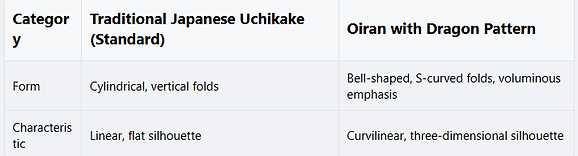
3.3 Clothing Form: Morphological Consideration on the Verticality of Japanese Uchikake and the Bell-shaped Silhouette of Oiran with Dragon Pattern
The formal characteristic of Japanese uchikake is vertical drapery due to its cylindrical structure. This is inevitable due to the tailoring characteristic of kimono. However, the lower part of Oiran with Dragon Pattern (c. 1810) deviates from the cylindrical shape and is voluminously puffed in a bell shape. This is an exceptional form in Japanese uchikake.
The noteworthy point is its expression technique. This soft bell-shaped curve and the volume of the drapery were not rendered with a brush, but engraved with a woodblock — that is, with a knife. Achieving such flexible curves elaborately in woodblock printing, where linear carving is mainstream, shows the high technical level of the artisan at the time.
On the other hand, Oiran with Tiger Pattern (c. 1810–1820) returns again to vertical drapery. Such a bell-shaped silhouette shares similarities with the expression of chima width seen in Shin Yun-bok’s Miindo, Ssanggeomdaemu, etc., examined earlier. Direct influence cannot be asserted, but it is a point worthy of attention in terms of morphological similarity.
Table 4. Comparison of Clothing Silhouettes
3.4 Sustainability of Distribution as Seen Through Comparison of Printing Techniques
As examined in Chapter 1, Section 1.4 Distribution, premium and popular types were classified and evaluated from the distribution stage itself. This distinction becomes clearer through a comparison of printing techniques.
Table 5. Division of Distribution Stage Through Comparison of Printing Techniques
Particularly in the case of Shunsen’s Oiran with Dragon Pattern, in the edition presumed to be the first edition around 1810, the dragon pattern is expressed in black close to ink color, while in the reprinted edition around 1830–1840, presumed to be after his death, it changes to a vivid blue. This coincides with the period of the aizuri-e (藍摺絵) trend following the import of bero-ai (Berlin blue) after the 1830s. This suggests the possibility that after the artist’s death, the publisher reprinted the work to meet demand in line with the trend, and the change in printing color itself can be said to be a representative case showing the sustainability and marketability of distribution.
3.5 Points Counted as Difference in Painting Comparison — Presence or Absence of Under-eye Shadow
A point counted as a difference in painting comparison is the presence or absence of under-eye shadow. One of the characteristics of Shin Yun-bok’s Miindo is the under-eye shadow (tear mole), which is a brush habit of fine lines repeatedly appearing in the expression of sensual beauties. On the other hand, such shadow does not appear in Shunsen’s Oiran with Dragon Pattern.
This paper does not view this as a simple technical limitation. Even in woodblock printing, fine dot expression is possible through dot techniques such as goma-zuri (胡麻摺り, sesame printing). Therefore, it is reasonable to interpret the absence of under-eye shadow as a selective omission according to the expressive norm of bijin-ga in ukiyo-e, which regards flawless, white-jade-like skin as ideal. That is, what was an element adding individuality in Joseon was converted into an element to be erased for ideal beauty in Japan, and this becomes a clue to understand the differences in overall form such as composition, color sense, and silhouette.
3.6 Comparison of Background Omission Composition
Formal similarity is also confirmed in the background treatment. While traditional Joseon court painters such as Kim Hong-do and Kim Deuk-sin generally compose narratives by placing landscapes or houses, Shin Yun-bok shows a break by completely deleting the background to white paper and highlighting only the figure. Shunsen’s case is also noteworthy. While typical ukiyo-e bijin-ga by Kitagawa Utamaro, Torii Kiyonaga, etc., actively utilize indoor and outdoor backgrounds such as pillars, windows, and gardens, in Oiran with Dragon Pattern the background is omitted as white paper.
This can be said to be a representative case showing compositional similarity in background omission — a form where the break in Joseon and the break in Japan meet at the same point.
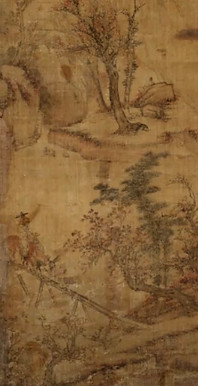
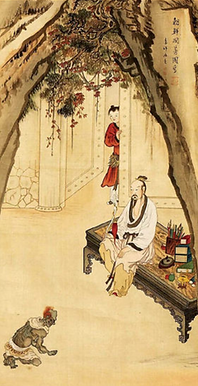
Which of these two works
looks like Shin Yun-bok’s work?
The answer is, both are attributed to Shin Yun-bok. The left is Giryeodogyo (Donkey Rider Crossing a Bridge, 1813), the right is Gosainmuldo (Figures from Chinese Classic Narratives, 1811).
If there is a difference, the left Giryeodogyo is a presumed work and in Korea is treated as his last official work. But doesn’t something feel strange? As I said before, an artist’s style cannot change this drastically in a short period.
The right Gosainmuldo clearly reveals his presence, just like Ssanggeomdaemu (Double Sword Dance) or Geune (The Swing) from Hyewon Jeonsincheop (Album of Genre Paintings by Hyewon — Shin Yun-bok’s art-name Hyewon — c. 1805, his most famous collection of 30 genre paintings). It looks like an extension of Hyewon Jeonsincheop, almost like an appendix.
In the center, the boy in vivid red that instantly grabs your gaze — the point color is given with jusa (vermilio). And he guides our gaze downward. An old man in a white dopo (a long outer robe worn by Joseon Confucian scholars). The triangular composition makes us focus entirely on these two figures. It is exactly the same method of directing the gaze that we saw in Ssanggeomdaemu and Geune. From Hyewon Jeonsincheop around 1805 to Gosainmuldo in 1811 — even after 5 to 10 years, his style has not changed at all. Rather, his worldview has expanded. The background story of this painting is not Joseon, but China.
On the other hand, the left Giryeodogyo, at first glance, evokes a vague sense of loneliness and pathos, like a tranquil landscape painting. There is no feature that draws the eye; it approaches merely as a depiction of a peaceful daily scene. Even if someone told me that the painter was not Shin Yun-bok, I would believe it — it is completely unlike the Shin Yun-bok we have seen until now. Some say that he soothed the loneliness of his later years by painting nature in leisurely ease. My thought is — well, I wonder.
Chapter 4. On the Phrase “The Last in 1813”
This chapter examines the circumstances of artist attribution for the four-panel screen Haengryeopungsokdo including Giryeodogyo, pil by Shin Yun-bok in the collection of the National Museum of Korea, currently known as Shin Yun-bok’s last work, based on the inscription “Gyeyu year, 1813.”
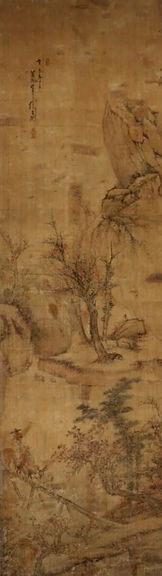
1. Subject and Problem Awareness
The work in question is the four-panel Haengryeopungsokdo (행려풍속도, Genre Scenes of Travel, scenes of travelers and everyday life on the road) known as “Shin Yun-bok pil Giryeodogyo etc.” in the collection of the National Museum of Korea, and has been presumed to be a work from when Shin Yun-bok was 55, based solely on the mukseo gwanji (handwritten colophon) that reads “Gyeyu year (1813).” Because only about 50 extant works remain, it has been given the symbolic status of the “last work.” However, it is necessary to examine whether scarcity itself can be a criterion that guarantees authenticity.
Here, attention should be paid to pil (筆, brush of) attached before the work’s title. In art historical catalogues, jak (作, made by) indicates a confirmed work where the artist’s own gwanseo (款署, signature and seal inscribed by the artist himself) is verified, while pil is a conventional expression used for attributed works that are considered to be by the artist based on style and brushwork but without the artist’s own direct gwanseo. That is, the four panels are already classified as an attributed work even in the owner’s own catalogue.
Above all, there is hardly any example where Hyewon directly inscribed the production year in any of his extant works.
-
Gwanseo (款署): First-order production information — signature and seals inscribed directly by the artist on the work.
-
Gwanji (款識): Second-order record — a separate sheet attached later by a collector or connoisseur to explain provenance or identify the artist.
In the case of this work, the artist’s own gwanseo is not confirmed, and there is an opinion that the basis for judgment is weak, as the attribution relies solely on the gwanji reading “Gyeyu year.”
2. Questions on Brushwork and Seal Form
Hyewon shows a relatively consistent brushwork through the 30 paintings of Hyewon Jeonsincheop. The brush lines are delicate and supple, alive down to each strand of hair. However, the gwanji of this screen gives the impression that the brushwork lacks golgi (骨氣, bone energy) and imitates the letterforms. The brush force is heobu (虛浮, empty and floating) and is far from Hyewon’s characteristic condensed brush line.
Also, unlike Hyewon’s earlier works which generally reveal his self-identity through the combination of gwanseo and doin (圖印, pictorial seal), in this screen the artist’s own gwanseo and seal are not confirmed. This is in stark contrast to the 1811 work Gosainmuldo, which declares its identity through a clear gwanseo and seal reading “Gagyeong sinmi (嘉慶辛未, 1811) Joseon-guk Hyewon sa (朝鮮國蕙園寫, painted by Hyewon of Joseon) Gyeongsa hwawon (京師畫員, court painter of the capital Hanyang).” For reference, sa (寫) here is a verb meaning “to paint,” an expression of self-respect indicating that the author himself painted it directly.
Giyeo Doggyo, attr. Shin Yun-bok (1813)
3. Re-examination of Stylistic Continuity
Age 55 is hardly an age at which skill would rapidly deteriorate. The figure handling and spatial composition seen in this screen appear somewhat distant from Hyewon’s prime works.
Furthermore, questions can be raised about the common theory that “because he was destitute, he painted commercial paintings on the market street.” If for commercial purposes, subjects with high demand such as gisaeng, genre scenes, and chunhwa (erotic paintings) would have been prioritized. The explanation that he painted a four-panel screen of sansuhwa (landscape painting) with low demand is less persuasive.
In particular, it is noteworthy that the range of stylistic change is large despite only a two-year gap from the 1811 work Gosainmuldo. Compared to the vivid coloration of imported pigments, the sense of immersion using triangular composition, and the theatrical direction utilizing the child figure in Gosainmuldo, the 1813 screen shows a markedly lower density.
4. In Lieu of a Conclusion — A Proposal for Re-examination
This study does not intend to conclusively judge Haengryeopungsokdo-byeong (행려풍속도병, Folding Screen of Genre Scenes of Travel — byeong means folding screen) as a forgery. However, it intends to raise that there is room for re-examination of the existing designation as the “last work” in terms of brushwork, seal format, and stylistic continuity. It is hoped that a more detailed understanding will be achieved through future precise chemical pigment analysis and comparative research.
So I decided to just leave 1813 aside. People say the writing and the seals on that painting look different from his other works. People say the painting style is different too. That's where all the debate and controversy is. That's not the story I want to tell. I decided to go where there's no dispute. To a year when we know for sure he was alive. To a time when his brush was still very much alive. To 1811, the last year that is clearly recorded. I decided to trust what is certain, rather than what is controversial. One painting with a certain date, and one line of record that crossed over to Japan. Maybe Hyewon was right there, where those two meet. My story doesn't start from 1813. It starts from 1811.
Gosainmuldo is a painting depicting a scene from the Chinese Samgukji (三國志, Romance of the Three Kingdoms). It illustrates the classic story of Samgo Choryeo (三顧草廬, Three Visits to the Thatched Cottage): the old man sitting on a rock in a white dopo is Jegal-ryang (Zhuge Liang), living in seclusion in the wilderness, and the boy in vivid red is the messenger who symbolizes Yubi's (Liu Bei's) sincerity in coming three times to seek him.
Shin Yun-bok compressed the story of Yubi visiting the thatched cottage three times into just two figures. Explanation is omitted, only emotion remains. He empties the entire background and concentrates the gaze on only two people with a triangular composition. It is the most tense moment — the instant just before a wise man emerges into the world.
This old story was familiar to Joseon seonbi (Confucian scholars), but it was a story especially revered in Edo-period Japan. Japanese bushi (warriors) revered Jegal-ryang as a god of military strategy (gunsa), and Samgukji was essential reading for the Edo buke (warrior houses). That the Joseon Tongsinsa (diplomatic mission to Japan) brought such a Chinese classic painting allows us to read the context of exchange at the time.
This Gosainmuldo, which had been in the collection of a Japanese collector, returned to Korea after about 200 years when it was purchased by a private collector in 2008, and was made public through an exhibition at the National Palace Museum of Korea in 2015. Currently, due to the owner's circumstances, it is not open to the public, and its exact current location is being confirmed. The whereabouts of the last work he left under the name of Joseon, Hyewon, still leaves many questions.
This is a Chinese classic painting drawn by Hyewon. It is the moment when the worldview of a court painter who had drawn yangban and gisaeng in Joseon expands. If his inscription had not been there, the original author of this painting would naturally have been thought to be Chinese. But he was very clever. In the inscription he accurately writes “Joseon-guk Hyewon.” That it was painted by Hyewon, the painter of Joseon. Just like Michelangelo engraving his own name on the Pieta, he put a final seal together with his inscription so that later generations would not be confused. And that too, not on a painting introduced in Joseon, but on a painting carried to Japan on the Joseon Tongsinsa. I was struck with admiration at that sentence. That sentence announcing his identity to the world — “Joseon-guk Hyewon.” I was completely captivated by his expression.
Gosa Inmuldo, Shin Yun-bok (1811)
Hyewon was a flamboyant man. The conventional theory that such a genius sold miserable commercial landscape paintings on the street contradicts his aesthetics. After King Jeongjo passed away in 1800, Joseon began to be consumed by sedo politics (in-law government) over three reigns — Sunjo, Heonjong, and Cheoljong. It was the prologue to a miserable downfall. How could the owner of such a flamboyant aesthetic not have known this? At the same time, Japan was actively accepting Western civilization and transforming into a modern state through the Meiji Restoration, while Joseon was mired only in Seongrihak (Neo-Confucian) rhetoric of justification, busy fattening the rice bowls of the sedo families. Even though Gojong, after Cheoljong, broke through sedo politics upon his enthronement, the foundation of the state had already collapsed beyond repair. 1813, the 13th year of Sunjo. In that Gyeyu year when people wailed that they could not live due to rotting sedo politics — a landscape painting? In Pyeongan-do, thousands died in Hong Gyeong-rae’s rebellion. In the court, the Andong Kim clan’s sedo politics began and the discipline of the nation collapsed. In such a year, when people wailed that they could not live due to rotting politics, are we to believe that the 55-year-old court painter Shin Yun-bok, hungry, had to sell paintings on the street market, carrying a four-panel landscape folding screen on his back, leisurely touring mountains and rivers and painting Haengryeopungsokdo (Genre Scenes of Travel)? Does that make sense? I even tried to think that he painted it to forget the miserable reality, but it was a work too different from his style to empathize with. The painting of a destitute person should smell of destitution. The painting of that era should smell of the blood of that era. But there is no smell at all in this folding screen. There is only a tranquil landscape. This feeling, so contrasting with the 1811 Gosainmuldo, only two years apart. What more is there to explain? Even if this 1813 painting is genuine, if it is his late work miserably painted because he was expelled from the Dohwaseo (Royal Bureau of Painting) and could not even obtain pigments because he ran out of money — this misery could itself be a motive for escape. So I ask. In 1813, was Shin Yun-bok really in Joseon?
Chapter 5. 1811, Did Shin Yun-bok Board That Ship? - The Life of Jungin, the Double Standard of Seongrihak, and the Last Joseon Tongsinsa
5.1 Status Limitation as Jungin and the Harsh Life of an Artist
Shin Yun-bok (申潤福, 1758–?) was a jungin painter of Joseon. His father Shin Han-pyeong was also a Dohwaseo (Royal Bureau of Painting) painter. In Joseon society, hwawon (court painter) belonged to the jungin (middle people) status. If a yangban (aristocratic literati class) painted as a hobby, it was recognized as pungnyu (refined culture), but if a jungin made a living by painting, it was disparaged as cheoneop (賤業, base occupation). Dohwaseo was a formal government office, but the salary of hwawon was meager. Their works decorated the sarangbang (reception room) of yangban houses, yet the painters themselves had to wait outside the main gate. Works were treated preciously, but artists were not — this dual structure was the reality of Joseon artists.
5.2 Sedo Politics after 1800, Dohwaseo Budget Cuts, and Expulsion
After King Jeongjo died on June 28, 1800, Andong Kim clan’s sedo politics (power monopolized by in-law families) began with King Sunjo’s enthronement, and the Dohwaseo budget was cut. Hwawon was a livelihood occupation. For a hwawon excluded from the institutional system to look outside for a living was a rational choice.
Shin Yun-bok was famous for pungsokhwa (genre paintings depicting everyday life), especially miindo (paintings of beautiful women) and chunhwa (erotic paintings). In Joseon, where Seongrihak (Neo-Confucianism) was the state doctrine, miindo and chunhwa were grounds for yubaed (exile). There was a double standard: yangban enjoyed them secretly, but when exposed, punished the hwawon. What had been tolerated while Jeongjo was alive became grounds for expulsion after Sunjo’s accession. In the Joseon Wangjo Sillok (Annals of the Joseon Dynasty), crackdowns on obscene pungsok increase in the early 1800s.
Eventually Shin Yun-bok was expelled from the Dohwaseo. The exact year of expulsion is not recorded, but after Hyewon Pungsokdocheop (circa 1805), his official government records are cut off. A hungry genius painter had nowhere to go. Domestically, he could no longer sell paintings.
5.3 Legal and Economic Differences Between Joseon and Japan — The Country Where Dragons and Beauties Become Money
In Joseon, the yong or ryong (dragon, especially O-Jo-Ryong, five-clawed dragon) motif was strictly controlled as a royal prerogative, and unauthorized use by commoners was punishable. Miindo and chunhwa were regulated as obscene material and were grounds for exile. Domestically, they were paintings that could neither be sold nor painted.
In Japan, by contrast, the dragon pattern was a symbol of supreme style (irezumi tattoo), and chunhwa (shunga) and bijinga (beautiful women paintings) were the highest-priced genres.
The economic difference was also decisive. In Joseon, jjokbit (indigo) and yeonji (safflower red) were cheap as domestically produced natural dyes but faded quickly. Japan’s Bero-ai (Prussian blue, bero blue) was a high-priced inorganic pigment imported through Dejima in Nagasaki, and maintains vivid saturation even after 200 years. It is a natural choice for the greatest painter to use the greatest pigment.
Of course, Japan in 1811 was also in the dark period at the end of the Edo Bakufu (Shogunate government). Due to the Bakufu’s sumptuary edicts, flamboyant paintings were superficially subject to crackdown. But it was different from Joseon. If Joseon enjoyed them secretly with a Confucian double standard and punished on the surface, Japan had a huge underground economy (yami market) even though the Bakufu banned them. Merchants of Edo and the commercial organizations of Kyoto and Osaka traded shunga and bijinga at even higher prices, evading the Bakufu’s eyes. The more banned, the higher the price went.
In short, Joseon was a country where if you sold, you died, and Japan was a country where if you sold, it became more expensive. Where a hungry genius would go was decided.
1811 was the year the last Joseon Tongsinsa was dispatched. It was a time when a smuggling route for pigments through the existing Tongsinsa line existed, and if reverse-direction movement was possible, it was the last escape route.
5.4 The 1811 Sinmi Tongsinsa — Structure and Blind Spot of the Last Incomplete Mission
The 1811 Sinmi Tongsinsa is a very special mission in the diplomatic history of Joseon and Japan.
-
Official name: Sinmi Tongsinsa (辛未通信使)
-
Dispatch year: 1811 (Sunjo 11th year)
-
Chief Envoy (Jeongsa): Kim I-gyo (金履喬, 1764–1832), a figure about whom evaluations of his official service are contested
-
Purpose: Congratulations for Tokugawa Ienari’s (徳川家斉) succession as Shogun. In the Joseon Wangjo Sillok, it is recorded as congratulation for the “investiture of the son of the King of Japan.”
-
Difference from previous missions: The previous 11 missions (1607–1764) all went to Edo, but the 1811 mission ended as Yeokji Bingnye (易地聘禮, exchange of state letters at an alternate location), exchanging state letters only at Eomwon (厳原) on Tsushima Island without entering Edo, due to the Edo Castle fire, famine, financial burden, and domestic turmoil in Japan. That is, an incomplete mission. This incompleteness itself is the structural gap that made reverse smuggling possible.
Academic significance: According to papers of the Joseon Tongsinsa Society, even after 1811, Joseon, the Bakufu, and the Tsushima Domain continued to negotiate for the resumption of Tongsinsa. “From 1811 onward, the dispatch of Joseon delegations was repeatedly postponed…” Although the official mission was cut off, the Waegwan (Japanese trading post in Busan) line remained alive. This means 1811 was not a disconnection but a transitional period when unofficial movement was possible.
This incompleteness is the very point of departure for this study. It was not an official route going to Edo, but actual negotiations were made between interpreters (yeokgwan) on-site at the Tsushima Waegwan. According to the record of Oda Ikugoro on the Japanese side, the Joseon Tongsinsa Society thesis notes that there were considerable actual exchanges that do not appear in the official Busan Waegwan records. That is, the Waegwan yeokgwan were the real window for diplomatic and smuggling trade, and personnel movement could be made secretly without remaining in official records.
The fact that Shin Yun-bok’s disappearance is around the early 1800s and the 1811 Tsushima mission overlaps. He could have boarded a ship going to Tsushima not as an official attendant but under the guise of being a relative or acquaintance of a yeokgwan. Tsushima is an intermediate base between Joseon and Japan, and from there, if he transferred to a Japanese ship, he could go to Osaka, Kyoto, and Edo. You cannot escape in a perfect mission. You can only escape in an imperfect mission. 1811 was therefore the last escape route.
5.5 Maternal Relative Interpreter Pi Jong-jeong — The Tsushima Voyage and Disappearance
In Shin Yun-bok’s maternal family there was an interpreter named Pi Jong-jeong (皮宗正) with the surname Pi (皮氏). In late Joseon, jungin painter families and interpreter families were closely intertwined through marriage. Both Dohwaseo hwawon and Busan Waegwan (Japanese trading post) interpreters belonged to the jungin class and worked through the same Waegwan network. In Joseon, interpreters were selected mainly from those with Waegwan work experience even among jungin, and practically handled not only Japanese interpretation but also document drafting and the smuggling trade of pigments, books, and ceramics.
The roster of the 1811 Sinmi Tongsinsa (Yeokji Bingnye, exchange at an alternate location) includes Jeongsa Kim I-gyo (金履喬) as well as Jesulgwan (drafting officer), Seogi (secretary), Yeokgwan (interpreter), Hwawon (painter), physician, etc. The quota was fluid, and according to the custom at the time, interpreter families could accompany Kwonsul (權率) — private attendants including relatives, servants, and acquaintances who did not receive a salary — separately from the official roster. Waegwan yeokgwan and Dohwaseo hwawon were typical occupations that operated Kwonsul.
This study presumes Pi Jong-jeong was a figure who traded pigments and books with Japanese interpreters through Waegwan interpretation, and focuses on the possibility that he was assigned as interpreter on the 1811 voyage. He departed Busan in lunar March 1811 and attended as interpreter at the meeting with Japanese representatives at Izuhara (Eomwon, 厳原) on Tsushima. At this meeting, he may have played a role beyond simple interpretation — as a broker introducing Joseon painters’ paintings to Japan.
After the Tongsinsa’s return (lunar July, Busan), Pi Jong-jeong’s later whereabouts are not confirmed in currently verifiable official records such as the Joseon Wangjo Sillok (Annals of the Joseon Dynasty, court-compiled official chronicles) 1811–1812 Waegwan yeokgwan lists, Tsushima Domain family documents, or Oda Ikugoro (小田幾五郎) records. He appears to have been deleted or omitted from the hojok (household register) and jokbo (genealogy) after 1812, and his grave, death record, and descendants’ records are also not confirmed.
This study pays attention to this point. The Tsushima voyage–return–disappearance of maternal relative interpreter Pi Jong-jeong. What if he was not a simple interpreter but the person who took his hungry genius nephew and connected him to a Japanese hwabang (畫房, painting studio), i.e., a broker and business director as we would say today?
Of course there is no physical evidence, so it is presented as imagination. The painting drawn at the request of maternal relative and interpreter Pi Jong-jeong is Shin Yun-bok’s Gosainmuldo (故事人物圖) (1811) mentioned earlier. In the jungin network, it was the most natural thing in that era for a maternal uncle (oesamchon, Pi Jong-jeong) to support his nephew (joka, Shin Yun-bok).
The production year of the extant Gosainmuldo can be cross-verified through Japanese official historical records and Korean records. According to primary sources such as Tsushima Domain documents, Tongsinsa Ilrok (Tongsinsa Diary), and reception records, the last Joseon Tongsinsa mission is the 1811 (Sunjo 11th year) Sinmi Tongsinsa, and the last reception was for Jeongsa Kim I-gyo and Busa (vice-envoy) I Myeon-gu’s party entertained at Izuhara (Eomwon, 厳原), Tsushima. The year Pi Jong-jeong went to Tsushima is 1811 in Korean records. If he carried the bunbon (粉本, draft/copy) of Gosainmuldo in that year 1811, then it is most natural to see the production time of that bunbon also as an 1811 work.
The important point is the schedule of the mission. The 1811 Yeokji Bingnye had about a 4-month stay from Busan departure (lunar March) to return (lunar July). While staying at Izuhara (Eomwon, 厳原) on Tsushima, official roster interpreters remain in records, but private attendants with Kwonsul (權率) status without salary were not listed on the official roster. That is, if Pi Jong-jeong was of Kwonsul status, his movement would structurally not remain in the documents. The defection of an official yeokgwan would necessarily be recorded as a diplomatic incident, but the defection of unofficial attendants such as Kwonsul has the structural characteristic of not remaining in official records. If during the return process it was disguised as death by illness (byeongsa, 病死) or drowning, the possibility that the death of a jungin would be recorded in court-compiled sources like the Joseon Wangjo Sillok is low. Considering that the Busan–Tsushima stay period of the 1811 mission reached about 4 months, sufficient physical time was secured to transfer ships at Tsushima and move to Osaka, Kyoto, etc..
5.6 The Painter Who Already Procured Bero Blue at Busan Waegwan and Used Deotchil
Shin Yun-bok was already procuring and using Japanese pigments in Joseon. Look at the blue skirt (cheongsaek chima) in Hyewon Pungsokdocheop. Joseon’s traditional jjokbit (indigo) is an organic pigment, so it fades to yellow in 100 years. However, Shin Yun-bok’s blue remains vivid even now, after 200 years. It is characteristic of the inorganic pigment Bero blue (Berlin blue, Prussian blue, imported pigment name Bero-ai ベロ藍).
Where did he get it? Busan Waegwan. At the end of the 18th century, Bero pigment was smuggled in through the Waegwan via Nagasaki, and Shin Yun-bok purchased that expensive pigment and was already using it with deotchil (重褙, backing and overpainting technique). This has been confirmed by detection of Bero blue in pigment analysis of Hyewon Pungsokdocheop.
In Joseon, if you drew yong or ryong (dragon) you were punished for treason, if you drew miindo you were exiled, but at the Japanese Waegwan that became money. The fact that Shin Yun-bok was already aware of the vividness of Japanese pigments and the demand of the Japanese market through the Waegwan is an important clue explaining his motive for going to Japan in material terms.
The fact that Hyewon’s death is unknown inevitably draws attention. In the Joseon Wangjo Sillok (Annals of the Joseon Dynasty, court-compiled official chronicles), Seungjeongwon Ilgi (Daily Records of the Royal Secretariat), and jokbo (genealogy), there is no death record anywhere. The painter Kim Hong-do, of the same era, has records of his disciples, property, and grave site even after his death, but only Shin Yun-bok has none. Why? The existing explanation that he was expelled from the Dohwaseo and merely lived miserably and ended his life cannot explain it. In 1811, the man who boldly declared his name as “Joseon-guk Hyewon” and painted that painting — the greatest painter of Joseon — would be missing just a few years later? This invites imagination of the possibility of leaving the country. I take this not as a conclusion but as the starting point of a hypothesis. If he boarded that ship? Did he take only that painting?
Chapter 6. Did He Take Only That Painting? — Beyond the Chunhwa Portfolio Imagination
This chapter expands imagination to its climax. As there is no physical evidence, it is presented only as bold imagination.
If in 1811 Shin Yun-bok was smuggled onto the Tsushima ship through interpreter Pi’s connection, would he have taken only one Gosainmuldo? Maternal relative Pi Jong-jeong and painter Shin Yun-bok — uncle and nephew. In 1811 Shin Yun-bok was 53 years old, and his maternal uncle Pi Jong-jeong, from his mother’s Hongcheon Pi clan, has no exact birth year in records, but judging from the family structure, he is estimated to have been 5 to 10 years older, in his late 50s to early 60s. Both were mature middle-aged men whose life experience was fully ripened. They were jungin status, but to them Japan was a foreign country where Joseon’s status system did not apply, and even if Shin Yun-bok could not speak Japanese, his maternal uncle Pi Jong-jeong was an interpreter who could speak Japanese fluently, so it cannot be overlooked that they could have traveled together as manager and business director in today’s terms.
Imagine. An uncle in his late 50s to early 60s and a nephew in his early 50s, two seasoned middle-aged men, in one room of a Japanese izakaya, selling shunga and drinking with Japan’s top oiran. In Joseon they were a despised jungin and an expelled painter, but there they were a foreign buyer who needed to mind no one’s eyes and Joseon’s first global artist.
He is a genius painter expelled from the Dohwaseo for drawing chunhwa. In Joseon chunhwa is subject to exile, but in Japan shunga (春画, spring pictures) was the highest-priced genre. Hokusai, Eisen, Kunisada all made money with shunga. The one painting I first saw, an oiran wearing a dragon-pattern uchikake. That culture itself is connected to chunhwa.
When the Joseon Tongsinsa came, a Hwandae-yeon (歡待宴, welcoming banquet) was always held. When the drinking deepened, would he not have taken out one secretly brought painting besides the official diplomatic gift Gosainmuldo? Japanese daimyo were crazy about Joseon-style chunhwa. If a hungry genius went to Japan, of course he would have brought another Joseon-style chunhwa portfolio.
Imagine the scene where interpreter Pi shows it to a Japanese workshop owner at a secret drinking party after the Hwandae-yeon ends, in one room of the Tsushima Waegwan or at Izuhara (Eomwon, 厳原). In the process of obtaining ship passage to other regions of Japan — Osaka, Edo — with the daimyo’s help, this one chunhwa would have become the most powerful business card. If the rumor of “Joseon’s greatest painter’s chunhwa” spreads to Osaka, if it spreads to Kyoto, if it spreads to Edo, moving to other regions of Japan would have been fully possible. But due to the nature of chunhwa, it would have been conducted extremely secretly, like a top-secret promotion carried out quietly, very quietly.
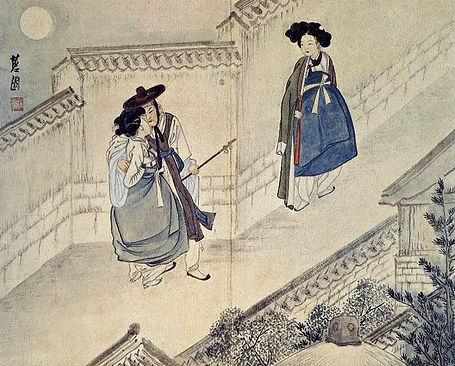
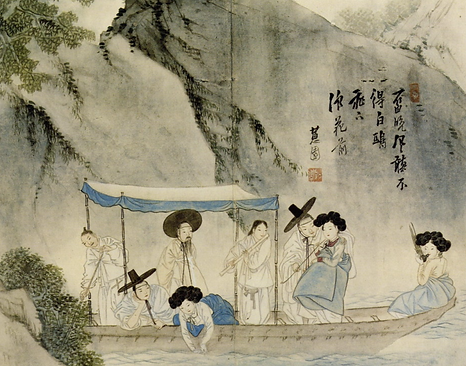
Left: Shin Yun-bok Wolya Milhoe (Moonlit Secret Meeting), Right: Juyu Cheonggang (Boating on the Clear River)
/ From Hyewon Jeonsincheop (Hyewon Pungsokdocheop) — Gansong Museum Collection / circa 1805
If Gosainmuldo was a diplomatic gift according to official procedure, the other would have been a 10-painting Joseon-style chunhwa-cheop (album) — a woman lifting her hanbok chima, a man and woman in the bushes, a sensual mole under the eye, Bero blue skirt and yeonji-beni or vermilion lips vivid in color. It is a portfolio that transformed the format of Joseon’s Chunhwa-cheop into the format of Japanese shunga. For example, it would have been paintings that converted compositions appearing in Shin Yun-bok’s chunhwa albums such as Wolya Milhoe (月夜密會, Secret meeting on a moonlit night), Juyu Cheonggang (舟遊淸江, Boating on the clear river) into Japanese-style tatami-room versions. Now do you understand? That one chunhwa at that drinking party, that one Japanese shunga in Joseon style, what a tremendous shock effect it would have. It is a unique situation that brings economic benefit to both the daimyo who connected him and Shin Yun-bok.
Of course, in 1811 Japan, chunhwa was not legal either. At the end of the Edo Bakufu (Shogunate government), flamboyant paintings were superficially subject to crackdown due to sumptuary edicts. But the place where Shin Yun-bok set foot was not the surface but the inside. If Joseon punished chunhwa in the shadows because of yangban (aristocratic literati class) face, Edo was different. The more bans were imposed, the bigger the underground market (yami market) grew. In the late Edo sumptuary ban period, when the Bakufu cracked down, merchants could not do business. Those who provided the venue and set up the market at that time were the bakuto organizations. The wealthy merchant had money, the bakuto had muscle, the tekiya had distribution. The combination of these three became what later became yakuza. Evading the Bakufu’s eyes, wealthy merchants of Kyoto and Osaka and the organizations protecting them created a huge underground economy trading miindo and shunga. There, crackdown itself was a price tag. The more banned, the more expensively it sold.
What if human desire that makes people want to buy more when banned, combined with the brushwork of Joseon’s genius court painter Shin Yun-bok, created a unique Japanese shunga? This itself would be an enormous shock.
Imagine. In one corner of that night market, in a tatami room lit by a single lantern, a wealthy merchant, the head of a Japanese merchant organization, unfolds Shin Yun-bok’s painting. He had already painted Joseon in Hyewon Jeonsincheop, painted Chinese gosa (classical stories) as a Joseon Tongsinsa diplomatic gift, and now imagine this scene where he is painting Japanese shunga. A Japanese-style shunga in Shin Yun-bok’s style never seen in Edo. Even if it is the same explicitness, the texture is different. If Japanese shunga focuses on exaggerated positions and comical expressions, Shin Yun-bok’s shunga is the hem of a chima, an ankle hidden by bushes, a single mole under the eye, a sensual aura emanating from the contrast of Bero blue skirt and beni lips. Subtle yet more erotic.
A merchant who truly knows how to recognize the real thing would recognize it at a glance. This is not a product but a monopoly. A single tag of “Joseon’s greatest painter’s chunhwa” would become a business card that shakes the entire Edo underground economy. So he does not ask. He does not ask the price. Instead, he locks the door. That night, Shin Yun-bok’s 10, 20 paintings disappear from the market. Not traded, but concealed. Because if you cannot keep it, you would at least make sure no one else can have it. So Shin Yun-bok’s journey to Japan had to be a top-secret promotion. Because it was too dangerous and too expensive. Perhaps because unlike Joseon which did not know how to recognize the value of his works, Japan had too many such wealthy merchants.
If before that it had been paintings drawn as a painter representing Joseon, after that he would never have drawn only subtly erotic paintings in Joseon style. They may have been too explicit for circulation even in Japan, or may have been transformed into other forms such as ceramic paintings or makura-e (枕絵, small erotic booklets placed beside the pillow) and sold. Or they may have been hidden in interpreter Pi Jong-jeong’s house and then disappeared. Such paintings cannot be openly carried. Because they were the very reason he was expelled from Joseon. So they would have disappeared more secretly, more deeply into this world.
Honestly, if a Joseon painter expelled from officialdom for chunhwa goes to Japan, the idea that he would bring only pungsokhwa (genre paintings depicting everyday life) and sansuhwa (landscape paintings) is not only against economic common sense but absurd. The imagination that he brought a portfolio is fully reasonable. He was a genius and a survival-type artist, so he would have taken not one but 10, 20 paintings.
The climax of this imagination led to an art-historical speculation about Hypothesis 2 of this report: the possibility of additional works being taken out. Of course it is imagination, but when the same year 1811, the daimyo’s economic motive, the stage of the Tongsinsa Hwandae-yeon, and the genre of shunga which was the highest-priced in Japan all align, Shin Yun-bok’s journey to Japan becomes a fully possible scenario.
Chapter 7. Integrated Consideration of Two Hypotheses + Chunhwa Portfolio Hypothesis: Imagination Is Endless — Judgment Is for the Reader
Hypothesis 1. Influence Hypothesis — Why the Inspiration Hypothesis Holds (Integration of Chapter 2 + 3 Evidence)
This hypothesis is not confirmed. However, based on facts confirmed in Chapters 2 and 3, it presents the possibility of inspiration and influence.
1. Formal Identity — Evidence from Chapter 2
First, omission of background. Kim Hong-do and Kim Deuk-sin fill narrative with mountains, rivers, and houses, and Utamaro and Kiyonaga also draw pillars and windows. But Shin Yun-bok’s Miindo and Shunsen’s Dragon Pattern Oiran both erased the background to white paper. The composition considered unconventional in both Joseon and Japan meets at the same point.
Second, clothing silhouette. Shin Yun-bok’s chima is a bell-shaped S-curve. Not an actual hanbok but an idealization that maximizes curved beauty. The formal standard of Japanese uchikake is cylindrical vertical pleats. Yet the lower part of the Dragon Pattern Oiran is not vertical but the same bell-shaped S-curve as hanbok. Realizing this soft curve on a woodblock carved with a knife is difficult to explain only by inertial transformation inside Japanese painter groups. (3.3)
Third, fine brushwork and facial modeling. The sensual coloring that dots red like a point, the use of an extremely fine brush, the inverted triangular face and sambaek-an (three-whites eye), the gache / mage (hairpiece) twice as high as reality. The two beauties share the same sculptural vocabulary.
2. The Process of Translation Seen Through Pigment and Technique — Evidence from Chapter 3
Fourth, choice of pigment. Shin Yun-bok shows a genius color sense using only jusa (vivid vermilion red) and Bero blue (vivid Prussian blue) for protagonists from Hyewon Pungsokdocheop (c. 1805) onward. (3.1, 3.2) In Shunsen’s early edition of Dragon Pattern Oiran (c. 1810) the dragon was black instead of expensive Bero blue, then in later editions in the 1830s–40s it changed to vivid Bero blue. (3.4) This is the publisher’s reprinting linked to the 1830s aizuri-e (blue-printed picture) trend, i.e., continuity of distribution.
Fifth, interpretation of difference. Presence of shading under the eye (tear mole). (3.5) In Shin Yun-bok it is a brushstroke that adds sensuality, but in Shunsen it is absent. This study does not see this as a technical limitation. On a woodblock where dotted expression is possible with goma-zuri (sesame printing), it is reasonable to interpret it as selective omission under the ukiyo-e norm that idealizes white jade-like skin. One dot erased rather becomes evidence of translation.
Based on these facts, Hypothesis 1 is established: Shunsen saw Shin Yun-bok’s iconography and did not change it because he could not draw it, but translated it into Japanese style. Since the dates are circa estimates, pre-1810 inflow cannot be excluded.
Hypothesis 2. Speculation on the Possibility of Additional Work Export (Integration of Chapter 5 + 6 Evidence)
This hypothesis is not confirmed. However, based on facts confirmed in Chapters 5 and 6, it presents the possibility of additional work export.
1. Jungin Had Nowhere to Go — Evidence of 5.1, 5.2, 5.3
Shin Yun-bok is a jungin painter. After King Jeongjo’s death in 1800, due to sedo politics (power monopolized by in-law families) the Dohwaseo budget was cut, and due to Seongrihak’s (Neo-Confucianism) double standard, miindo and chunhwa became subject to crackdown. (5.1, 5.2) Official court records are cut off after Hyewon Pungsokdocheop around 1805. The legal and economic difference is also decisive. In Joseon, dragon iconography and chunhwa were subject to punishment, but in Japan dragon tattoos were a symbol of style and chunhwa (shunga) was the highest-priced genre. Joseon was a country where if you sold you were punished, and Japan was a country where the more it was banned, the more expensively it sold in the underground economy. (5.3)
2. 1811 Was the Last Escape Route — Evidence of 5.4, 5.5, 5.6
The 1811 Sinmi Tongsinsa was an incomplete mission, a Yeokji Bingnye (exchange at an alternate location) that ended at Izuhara (Eomwon, 厳原) on Tsushima without entering Edo. This incompleteness is a structural gap. Interpreters on the official roster remain in records, but private attendants with Kwonsul (權率, private, unsalaried attendants including relatives, disciples, and servants, customarily accompanying the mission separately from the official roster and therefore not listed in court-compiled records) do not rise to the official roster. The departure of an official interpreter is a diplomatic incident, but the departure of a Kwonsul is a structure that does not remain in historical records. (5.4)
There is the existence of maternal relative interpreter Pi Jong-jeong (皮宗正). Jungin hwawon–interpreter families were tightly linked by marriage, and interpreters were in charge of the smuggling trade of the Waegwan line. He had the possibility of being assigned as interpreter at Tsushima in 1811, and his whereabouts are not confirmed in official records after the Tongsinsa’s return. This study notes the possibility that he was not a simple interpreter but a broker who connected his relative to Japanese painting studios. (5.5)
Finally, evidence of pigment. Shin Yun-bok was already in Joseon obtaining smuggled Bero blue (Bero-ai ベロ藍) through Busan Waegwan and using it with deotchil (overpainting) technique. The blue that does not fade even after 200 years physically explains his awareness of the Japanese market. (5.6)
Based on these facts, Hypothesis 2 is established: If Shin Yun-bok boarded the 1811 Tsushima-bound ship as Kwonsul status, the possibility that he took only one diplomatic gift Gosainmuldo does not match economic rationality. The possibility that an additional Joseon-style chunhwa portfolio accompanied it. As there is no physical evidence, it is presented as imagination.
Chapter 8. Conclusion: Both Miin-do Are National Treasures
This writing began with a single question.
Why was his death never recorded?
Hyewon Shin Yun-bok. The hwawon who painted the greatest Miin-do of Joseon. His death year is unknown. In the Joseon Wangjo Sillok and the Seungjeongwon Ilgi, there is not a single line announcing his death. I began this imagination from that blank.
This report does not claim to know the truth. There is no physical evidence that Shin Yun-bok went to Japan. Therefore, I do not assert. I have merely recorded comprehensively the traces left by paintings in a blank space that was never recorded. The vivid chroma of Bero blue, the bell-shaped silhouette of an uchikake puffed up like hanbok, the audacity of erasing the background, and the common sense that a genius’s brushwork cannot collapse within a narrow time frame. Each one could be coincidence. But when they appear collectively in one painter’s one period, I could not stop questioning.
And finally, I arrived at this question. Arguing who copied whom is meaningless. What matters is that both paintings are masterpieces of national treasure caliber. Just as the Miin-do in the Kansong Museum is a treasure of Korea, the Oiran Wearing a Dragon-Patterned Uchikake (Black Dragon edition) in the British Museum is a masterpiece of national treasure caliber that marks the pinnacle of Japanese aesthetics. Although, due to the characteristic of woodblock prints, we cannot call both the c. 1810 Black Dragon edition and the later c. 1830–1840 Blue Dragon edition national treasures, the artistic achievement contained within is worthy of being called a national treasure. Personally, I prefer the Blue Dragon edition held by the Legion of Honor in San Francisco, USA. I still cannot forget that vivid blue embedded in my mind.
Both Miin-do deserve to be treated as national treasures in their respective countries. This report is a record of one digital creator’s imagination that those two masterpieces may have met from the same root. I hope this writing becomes not a conflict between Korea and Japan, but an opportunity to look at paintings more closely.
As there is no evidence, this report remains as imagination. I hope that in the future, this imagination will be verified or refuted through X-ray fluorescence analysis and woodblock species analysis, and reinvestigation of the Tsushima clan documents.
I will add just one last imagination and close this writing.
1811, Tsushima. The last night of the incomplete Tongsinsa. A banquet hosted by a Japanese daimyo. A drunken Joseon interpreter, and beside him, Joseon’s greatest painter.
Did that painter really just show a single light seonsu-hwa (線手畵, line sketch) and return? In the midst of thick jokes at the drinking party, was there not a single painting slightly pulled out from his bosom? “In Joseon, there are also paintings like this.” That one painting may have been the beginning of smuggling trade. And that one painting may have been the beginning that made the two Miin-do resemble each other.
The truth is unknown. However, I, if I were Shin Yun-bok, would have gone. As an artist, to a place where my paintings can spread their wings, a place where I can freely obtain pigments, and above all, a place where someone will recognize my Miin-do. At that time, his New World would have been Japan.
Chapter 9. Research Ethics Statement
I, aushanelee, focused on the fact that the death of Shin Yun-bok, the ill-fated genius painter of Joseon, remains unknown, and imagined that he could well have gone to Japan. Because one must earn money and make a living. Born as jungin and living a barren life as an artist under the double standard of Seongrihak (Neo-Confucianism) before being expelled — knowing the vicissitudes of his life, I find the theory of his journey to Japan even more persuasive.
This hypothesis starts from these points: at that unknown point in time, a masterpiece of national treasure caliber reminiscent of his style appeared in Japan; this coincides with the period of Joseon’s decline; the last Tongsinsa in 1811 was an incomplete mission that ended at Tsushima; and his maternal relative, interpreter Pi Jong-jeong, disappeared after accompanying the mission to Tsushima.
I have no intention whatsoever to disparage Japanese works. This is merely a hypothesis derived from recognizing Shin Yun-bok’s characteristics within that painting, and I clearly state that I have no intention to deceive.
I simply felt Shin Yun-bok’s Miin-do in Japanese style from this painting. And I conclude this writing by adding one final economic imagination: if he was an unrecognized genius who was chased out for chunhwa in Joseon, in Japan he could have become a genius recognized for chunhwa, and could have obtained both money and fortune at once.
References
-
British Museum, Collection Online, Oiran wearing black uchikake with dragon motif
-
Lyon Collection, Woodblock Prints Database, Katsukawa Shunsen, Kakemono of an oiran in a black uchikake decorated with a dragon in a night sky [1810c Shunsen lineless]
-
Bonhams, London, Japanese Woodblock Prints, 5 Nov 2009, Lot 67
-
Invaluable, Auction Database, Katsukawa Shunsen Kakemono-e sales record
-
Wikipedia, Katsukawa Shunsen biography, late 1820s ceased prints and devoted to ceramics
-
Artelino, Katsukawa Shunsen - Ukiyo-e Print Designer and Ceramic Painter
-
Joseon Tongsinsa Wikipedia, 1811 Tongsinsa incomplete Tsushima
-
Society for Joseon Tongsinsa Studies, Verification of the Official Uniform of Chief Envoy Kim I-gyo of the 1811 Sinmi Tongsinsa, Journal of Joseon Tongsinsa Studies Vol.31
-
Cultural Heritage Administration, National Cultural Heritage Portal, Designation Status of National Treasures and Treasures
-
Cultural Heritage Administration, Joseon Wangjo Sillok, Seungjeongwon Ilgi, Genealogy, Dongnae-bu Waegwan Byeolcha Registry, Tsushima Sō Clan Documents, Documents related to Pi Jong-jeong
-
Jeongjo Sillok, Sunjo Sillok, Dohwaseo-related Records
-
Kim Hong-do, Songha Maenghodo, Jukha Maenghodo
-
Shin Yun-bok, Hyewon Pungsokdocheop, Miin-do
Epilogue: In Search of the Painting That Was Not Burned
How erotic must his chunhwa have been to be expelled from the Dohwaseo?
I am truly curious. It is a painting I want so badly to see, but it is a painting that does not remain. Like Hwang Jini (黃眞伊, 1506–1567), the famous gisaeng of Joseon — it is said she was outstanding not only in writing but also in painting, yet is not Korea a country where not a single painting of hers remains today? In Joseon, she was cheonmin and Shin Yun-bok was jungin. Is there any need to say more?
This writing is not a thesis. It merely borrows the form of introduction, body, and conclusion; in academic completeness, it is a zero-point fictional theory.
I imagined one thing. What if Hyewon Shin Yun-bok, in 1811, crossed to Japan to escape the pointing fingers of the world and the erasure of records.
1811 is the year the last Joseon Tongsinsa visited Tsushima. Hyewon’s last painting record also breaks off around that time. Whether incorporated as a Tongsinsa painter or taking a merchant ship of the Waegwan, the most plausible year for him to disappear is 1811.
A genius paints anywhere. No matter how he lives, his skill cannot help but show. If he picked up a brush somewhere in Japan, perhaps in a temple or in the tatami room of the Waegwan, he surely drew eroticism not by the grammar of Japanese shunga, but by the grammar of Joseon. I searched for surviving chunhwa in Japan to find that trace. And I soon hit a wall. Chunhwa is not an artifact in a museum’s glass case. It is a private history, secretly inherited for 300 years, from a daimyo’s secret drawer to a private collector’s safe in Ginza. Because it is called obscene painting, there is not even a catalog on the internet. So I could not prove it. So this writing remains as faction.
But if — if it really happened — he surely would have painted like this. Like this painting.
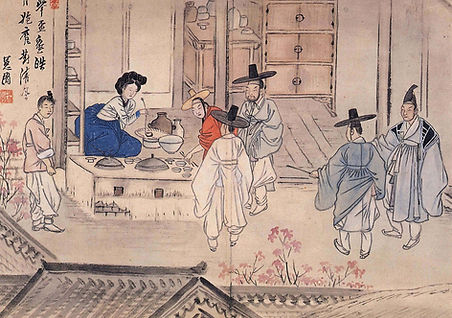
Not exaggerated and twisted like Japanese shunga, but with a bold diagonal composition like the skirt fold of a Joseon woman, and that vivid color used on the woman’s skirt in this painting — the Bero (Prussian) blue that had just arrived from the West. It is a color that can never be achieved with traditional indigo. In Joseon painting, this brilliant imported blue only appears in full scale around 1805, when Hyewon Pungsokdo was painted. A color that did not exist in Joseon paintings before that, so this blue itself is evidence of time. A color that only a genius after 1805 could use.
There is no chunhwa of his in Korea. Because they were all burned. The few that are said to remain are merely low-level genre paintings; the established theory is that not a single piece of his true chunhwa, containing his real desire and genius, remains.
So I ask in reverse. If it was burned because it does not exist in Korea, could it not exist in Japan?
Jusageobae (Raising a Cup at a Tavern), Shin Yun-bok (c. 1805)
I earnestly ask the private collectors in Japan and around the world who are reading this.
Check if the line is as clean as a knife, if the woman’s face is in Joseon style, and if that Bero blue is used on the skirt.
A chunhwa painted in Hyewon’s style could certainly exist.
One unburned painting, somewhere.
Please take another look at one anonymous chunhwa in your collection.
The pen name of the late Joseon painter Shin Yun-bok is Hyewon (蕙園). The currently accepted theory interprets Hyewon as Hyecho Jeongwon (蕙草庭園), or "a garden of common grass" — a self-deprecating name where he likens himself to a pitiful, ordinary weed. However, aushanelee does not agree with this interpretation. This is a reading filtered through the Neo-Confucian lens of Joseon, and it is yet another curse created by an era that burned his paintings for being "un-Confucian" and erased him from the records.
1. The Original Meaning of the Hanja (本義)
You must read a dictionary to the end.
Hye (蕙) primarily means hyecho, a type of grass, but its secondary meaning is hyangcho (香草), a fragrant herb. It is a precious plant of the orchid family, which Confucius and Qu Yuan used as a metaphor for "the fragrance of a virtuous man" — a subtle yet lingering scent that does not fade, like the afterglow that remains after viewing a painting. All historical anecdotes related to it are praises.
-
Hyejil Nansim (蕙質蘭心): A beautiful and noble heart, like an orchid.
-
Hyesim Wanjil (蕙心紈質): A person whose heart is as fragrant as hyecho and whose character is as fine as white silk. It was the highest compliment given to the greatest gisaeng and talented women of the time.
The Difference — and Interchangeability — of 園 (Won) and 苑 (Won)
Originally, his seal reads 朝鮮國蕙園寫 (Joseon Guk Hyewon Sa) — using 園.
-
Won 園 (garden): A fenced orchard or vegetable patch. A plain, humble field anyone can cultivate.
-
Won 苑 (royal garden): A royal garden (苑囿, Won-yu). The nation's finest collection of all rare plants, animals, and beautiful things — a grand hall or pantheon. A place of study and art.
What is crucial is that in late Joseon, these two characters, sharing the exact same pronunciation, were frequently interchanged in documents.
Even if Shin Yun-bok himself wrote 園, the spirit he contained is closer not to 園, but to 苑.
苑 (Won), like 園, primarily means garden, but secondarily means a royal garden (苑囿). It signifies the nation's supreme collection of all rare and beautiful things — a pantheon (殿堂).
-
Yewon (藝苑), Munwon (文苑), Hwawon (畵苑): A pantheon where art, literature, and paintings are gathered.
-
Gyuwon (閨苑): A garden where beautiful women gather — Shin Yun-bok's own artistic world itself.
Therefore, combining Hye and Won does not mean "a pitiful field of grass," but rather "a pantheon of art where fragrant things gather."
He wrote it as 園, but we must now read it as 苑. Hyewon (蕙苑) Shin Yun-bok.
2. A New Interpretation
Shin Yun-bok was a painter who spent his life in gibang (courtesan houses), mingling with the sons of yangban aristocrats. What he painted — Wolhajeongin (Lovers Under the Moon), Juyucheonggang (Boating on the Clear River), Yeonso Dapcheong (Young People Strolling in Spring) — were the most splendid and expensive moments in Joseon. His painting style, which lavishly used costly pigments, is also far from ordinary. No artist would call himself "common grass" in his own brand — his pen name.
Hyewon should be read like this:
"Fragrant lingering (蕙) remains in my gallery (苑)."
"Fragrant herbs subtly linger in my collection."
And going one step further, from a global perspective, it expands to:
"I will make the entire world my garden."
Perhaps a gisaeng, after seeing his painting, said to him, "Your paintings are just like Hyewon. It's like walking through that garden." That one phrase may have become his pen name. Who named him is not important. What matters is the hidden meaning.
We must now call Hyewon again. He wrote it as 園, but I now read it as 苑. Not the Hyewon disguised as pitiful grass and erased, but the artist who had a fragrant gallery, the first global artist of Joseon who sought to make the entire world his garden — Hyewon (蕙苑)! Shin Yun-bok!
On the Pen Name Hyewon (蕙苑) of Shin Yun-bok
September 28, 2026, aushanelee

"No one knows where he went. But I feel it. If it were him, he would have gone to a wider world." - aushanelee ✍️